|
---------------------------------------------------
A personal message
This Sunday, the third of Tammuz (July 29), marks the 31th yahrzeit of the Lubavitcher Rebbe, Menachem Mendel Schneerson, obm. Much of the Jewish world recognizes the legacy the Rebbe left us and therefore commemorates this day. It is a time for reflection and introspection, but above all is a time for renewing and strengthening commitments.
It is due to the Rebbe’s unique and revolutionary vision that we are here, an integral part of Tallahassee and its Jewish community, of FSU, and of the Florida State Capital. And it’s why our doors are always open 24/7.
For a brief recap of the Rebbe’s influence and impact,
click here.
For a brief biography,
click here.
---------------------------------------------------
Rising up to the Occasion
This week’s portion (
Korach) recalls the rebellion of Korach and his followers.
Korach is an antagonistic figure. He is more than just a trouble maker; he not only questions Moses’ leadership - he actually leads a revolt against it. But this is more than a case of “the good guy (Moses) always wins”. It is also a display of Moses’ concern for the unity of the Jewish Nation, and it shows the lengths he was will to go to in order to preserve it.
A brief recap
Korach and his two leading accomplices, Datan and Aviram, challenge Moses’ and Aaron’s leadership, claiming “You take too much upon yourselves, for the entire congregation is all holy, and G‑d is among them. Why do you exalt yourselves over the congregation of G‑d?”(Numbers
16:3).
Although the ensuing revolt eventually numbered only 250 people, it threatened to lead to a divisive split within the Jewish nation.
Eventually, after attempting to offer ketoret (incense), which is reserved for priests, G-d “steps in” and puts an end to the uprising by “opening the earth and swallowing Korach and his followers”.
Moses preempts G-d
In the midst of all this something remarkable happens. Even before G-d “steps in”, Moses takes the initiative and does his own “stepping in”.
G-d had instructed Moses to warn those wanting to join the rebellion to “withdraw from the dwelling of Korach, Datan, and Aviram”. And indeed Moses did so, as the Torah states “Moses arose and went to Datan and Aviram…”(Numbers 16:24-25).
Why “arose”?
Something odd here – why mention that “Moses arose…”. Obviously, in order to go somewhere (Moses “went to Datan and Aviram “) you must first stand up. If so, why does the Torah need to state that Moses “arose”?
Chassidut explains the deeper significance of “Moses arose”. Moses did not doubt G-d's promise to overcome the rebellion. Yet, despite knowing that he was the “good guy”, and despite being assured of ultimate success, Moses felt compelled that he must first do the utmost to maintain unity among the Jewish people. He had to act; he had to try to convince the rebels to reverse their treacherous path.
Unity above all
So important was the principle of unity that Moses spared no effort to achieve it. He could have stood on protocol and personal honor. After all, as G-d’s appointed leader of the Jewish Nation, he could have expected Datan and Aviram to follow protocol and come to him; Moses could have demanded the respect due his position.
But no!! Instead, he put his own prestige aside for the higher purpose of maintaining unity. Thus, when Moses “arose”, it was more than just standing up to go somewhere, he actually “arose to the occasion”, foregoing his status in order to be able to confront the challenge of maintaining continued unity within the Jewish Nation head-on.
Arising to the cause
We must follow Moses’ example and take the lead (and sometimes even the initiative) in promoting Jewish unity. It is the one factor that ensures not only our survival, but the quality of our very existence.
Moses put all personal considerations aside in order to assure that the Jewish Nation should remain one. We must do likewise.
And especially this year, by doing so, we reaffirm that Am Yisrael chai!!!
With heartfelt prayers for Am Yisrael and Israel, Shabbat Shalom!
<<<<<<<>>>>>>>
Did you know that...
The recent conflict between Israel and Iran was called “Rising lion”, based on the verse “Behold, the people shall rise up as a great lion” (Numbers 23:24). Aside from being “king of the animals”, the lion is actually quite prominent in Jewish tradition.
Click here for an in-depth look.
Rabbi Schneur Z. Oirechman
---------------------------------------------------
|


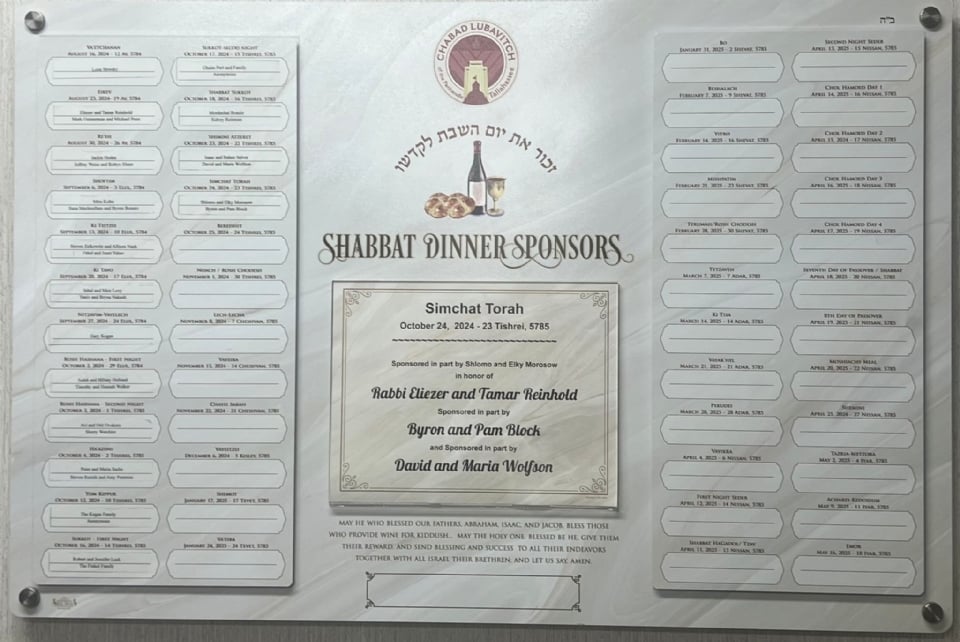 Shabbat sponsors are $1800 and are honored on our Shabbat Sponsor Plaque.